Sunday, May 10, 2009
I was watching the Daily Show last week, and i saw this segment on Pakistan and their problems with the Taliban. I didn't think all that much of it then, even though it was interesting, but while i was writing my simulation reflection this afternoon, i thought about how it connected to many of the things that i have learned throughout this unit. I think that Jon Stewart does a great job satirizing the relationship between the United Sates and the affairs of the Middle East, and in fact the situation in the Middle East as a whole. The way that the situation in Pakistan is depicted, Stewart shows a large difference in what the United States expected when they sent $10 billion to the Pakistani government to counter terrorism, and what they have actually done with it. He also shows how the U.S. has also been unsuccessful in their war against terrorism, and how perilous a situation Pakistan is actually in. According to the segment, which is admittedly a comedy show, but also a reasonably trustworthy view of current events, the Pakistani government is on the verge of collapsing, the Taliban is close to reaching a major city, the nukes are possibly in danger, and the President is in America asking for help. The way it is shown makes it seem like the Pakistani president is using America's economic power as an argument that we should be giving them money. Seeing as America is already dedicated to fighting terrorism, and helping Pakistan would be beneficial, the President has a point. At the same time, it seems like they are just taking advantage of us because we're locked in. The point i'm trying to make is that this unit has taught me not to trust any one dialogue in regards to a political or military crisis, and to see the problem from all sides. This show connects that lesson to a current topic, and reinforces McNamara's argument that you need to understand how you're enemy feels, and act accordingly.
By the way, hulu.com is a fantastic place to get any video clips from shows, it lets you embed clips in, choosing which segment of time from the video. It also has a huge collection of tv shows and movies, and is legal. Check it out

Monday, May 4, 2009
Iran Cartoon

I often find that cartoonists have some of the most interesting ways of portraying a topic. In the case of Iran and Mr. Ahmadinejad, i found this picture. As we were talking about some connections between Ahmadinejad in class today, i thought it was particularly relevant. It was noted that when Hitler first took power, nobody really believed that he would do all the things that he had said he would do. Hitler wasn't taken seriously, and we all know the end result. What i find interesting are the parallels between Hitler and Ahmadinejad, obviously pointed out in this cartoon, with the "Hitler Moustache" spelled out as Iran, and the atomic bomb exploding in his eye. Some people are arguing that Ahmadinejad's threats are not to be taken seriously, and while they may be right, the consequences of being wrong are severe. I think that this image effectively captures the fears of many people. It includes a suggestion of nuclear war, as well as another holocaust (with the connection to hitler), and gives an overall sinister image of Iran. As McNamara was saying in "The Fog of War", everybody in positions of power make mistakes, and even if people don't like to admit them, the least they have to do is to learn from them. If Ahmadinejad and his promise towards the eradication of Israel and hostility to the western world are legitimate, then we have a situation not completely dissimilar to that which America had to deal with Hitler. This image seems to suggest that we need to learn from our mistakes in the past, and not allow the Iranian situation to break out into war, for now that atomic weapons have been brought into the mix with arguably equally irrational leadership, the stakes have been raised. Again, as McNamara said, there is no learning period with nuclear weapons, just the destruction of nations.
Sunday, April 19, 2009
Since we were exploring visual arguments in regards to war, i wanted to look at some commercials for the U.S. Army and Navy. I tried embedding a couple that i found on youtube, so hopefully they work. If not, here are the links http://www.youtube.com/watch?v=JDXK1dFY_Pc, and http://www.youtube.com/watch?v=8MorDCtBPR8&feature=related.
In watching these videos, i was struck by how completely they ignore certain aspects of going into the army. Though i had seen them on tv before, this time i was comparing them to the images and videos that we watched in class last week. I thought immediately of the set of pictures that we investigated, with the picture of Dresden after the bombing, then on the children in Vietnam, then the dead U.S. soldier, and finally the U.S. soldier with the child. If you look at each of these pictures as a different side of war, one being massive destruction, the second being the trauma and horror that is dealt to innocent people, then the third being death, and the last one, the only positive one, being the army helping people and making people happy again. I feel that these commercials barely even cover one of these sides of the army. For a brief second in the army commercial you see them helping civilians out, but apart from that, both commercials are focused solely on self-improvement. The navy commercial talks about why getting an education with the navy would be great (the ship, of course), and the army talks about the "strength" of being a U.S. soldier. Neither of them even suggest fighting, or the possibility of death, or the destruction towards innocent people. While it's logical that this would be the case of a recruitment tool, it makes me wonder whether it fundamentally changes the way we all see the army. If all we ever see are glorified self-improvement videos, what is the mindset of people who actually sign up. Maybe the idea of death is pushed aside, and we only expect success. I think that instead of advertising how the Army and the Navy can improve our own lives, it should advertise the importance to help others around the world, and to protect citizens, at least then people might enlist more for the goal of service than to help themselves out.
College Kids Hit By Recession

Of all the things i want to do with my life after graduating from college, paying off thousands of dollars of debt is not on the list. However, this is growing to be the case for a majority of college students, and whether it is due to irresponsible spending or unfortunate circumstances due to the country's economy, they're feeling the strain. I recently found an article on CNN that talked about how college students were relying more on their credit cards than in earlier years. It stated that
"students are carrying record-high balances: an average of $3,173 for undergraduates, up 46 percent from 2004; and more than $4,100 for graduating seniors, up 41 percent from 2004."
While it does suggest that this is partly due to the rising costs of colleges, it more points to the recession as the cause of this increase. In particular, one student was interviewed, and he admitted that he has not been spending money very intelligently. As well as paying for college, he was paying for two luxury cars on his credit card. However, he has since changed his ways and is now working, attending a community college instead, and not using his credit cards.
I think that this student is a good example of today's kids in general. While it is their parents who work most of the time, and have the major financial responsibilities in the family, the kids have had to change their ways as well. I know that i have had to reduce spending almost to nothing, and i have been trying to get myself a part-time job for some time. Based on my difficulty getting a job, i assume that there are a lot of kids in the same situation.
I would be interested to see how the economy has affected kids at New Trier. Considering the fact that we live in a wealthy area, and the lifestyles of many is rather extravagant, i am sure that many kids are starting to realize that they can no longer afford to live the same way that they have been. It is not just our parents that have to be financially responsible, but it is us too. Any way that we can help to relieve some financial strain is important. I guess that the lesson learned from this article on college students racking up debts on their credit cards is that we all have to cut back. It seems that it would be logical not to buy something that we can't afford, but as a society, America has been in that habit for some time. I think that very soon, people are going to start changing this trend and make a few more sacrifices to avoid debt.
Sunday, April 12, 2009
Recession Pictures
Following the videoconference that we had on thursday, i wanted to write a blog post in which i found a way to connect some form of artwork to the recession/depression. While i didn't find one specific artifact, i found a page from the New York Times in which they had encouraged people to send in their pictures representing the economic troubles. While i can't bring out any of the pictures and put them onto this post, here's a link to the page. http://www.nytimes.com/interactive/2009/04/02/business/economy/economy-user-photos.html#/0/.
Much like the pictures we looked at from the Great Depression of the 1920's, these pictures subtly displayed the general mentality of the economy not only in the U.S., but around the globe. One of the pictures i thought was very interesting was a picture of a man dressed in a suit, standing on a street corner holding a sign saying, "Not looking for a handout, Just Need A Job". The caption says that there is a phone number written on the back of the sign. This picture, along with many others reminded me of the pictures from the 20's of businessmen either sleeping on the ground, or walking long distances, or looking for jobs in general. There was one picture that looked almost identicle to the one of people lining up down the street looking for a job.
Overall, there was an eerily similar appearance between these pictures and the ones we explored in class. I suggest looking through them, because there are far too many for me to describe, but together they provide an interesing perspective to the economic struggles of all people, businesses, and countries.
Much like the pictures we looked at from the Great Depression of the 1920's, these pictures subtly displayed the general mentality of the economy not only in the U.S., but around the globe. One of the pictures i thought was very interesting was a picture of a man dressed in a suit, standing on a street corner holding a sign saying, "Not looking for a handout, Just Need A Job". The caption says that there is a phone number written on the back of the sign. This picture, along with many others reminded me of the pictures from the 20's of businessmen either sleeping on the ground, or walking long distances, or looking for jobs in general. There was one picture that looked almost identicle to the one of people lining up down the street looking for a job.
Overall, there was an eerily similar appearance between these pictures and the ones we explored in class. I suggest looking through them, because there are far too many for me to describe, but together they provide an interesing perspective to the economic struggles of all people, businesses, and countries.
Sunday, March 8, 2009
Advertising: Science or Art
I don't know about any of my classmates (except for McClone), but i was somewhat irritated when we looked into how advertising worked last week. Though i am generally pretty skeptical of advertising anyway, just seeing and talking about how advertising agencies play on social fears made me feel like the entire industry is designed to manipulate us past seeing the actual products that they are trying to sell, and instead makes us think about what other people will think of us if we buy the product or not. It's just not right!
Anyways, there is often a debate about whether advertising is an art or a science, or both. Based on what i know of advertising, i feel that while it is definately a mixture of the two, it is the science aspect of the advertising that is dominant. I have a little insight to this because my dad works in the market research business, which more or less means that the company he works for collects research on consumer behaviour. Through seeing some of his work and talking to him about it, i was surprised by how much effort companies put into knowing how their customers act; who buys what, when, and why they do it.
It doesn't seem to matter what the product is, big or small, cheap or expensive, they all go through this process of understanding what the consumer wants, from underwear to luxury cars. For example, today i learned about reinforcement advertising, where advertisements are specifically designed simply to reinforce the buyers decision after they already own the product, as if to convince them that they made the right choice. Supposedly this is common in car commercials.
Anyways, there is often a debate about whether advertising is an art or a science, or both. Based on what i know of advertising, i feel that while it is definately a mixture of the two, it is the science aspect of the advertising that is dominant. I have a little insight to this because my dad works in the market research business, which more or less means that the company he works for collects research on consumer behaviour. Through seeing some of his work and talking to him about it, i was surprised by how much effort companies put into knowing how their customers act; who buys what, when, and why they do it.
It doesn't seem to matter what the product is, big or small, cheap or expensive, they all go through this process of understanding what the consumer wants, from underwear to luxury cars. For example, today i learned about reinforcement advertising, where advertisements are specifically designed simply to reinforce the buyers decision after they already own the product, as if to convince them that they made the right choice. Supposedly this is common in car commercials.
Either way, our class last week regarding advertising just made me more aware of what i actually see when i see a commercial, and though i am no longer irritated by them, i am definately more intrigued to figure out what the advertisers were thinking when they made the comercial.
Wednesday, March 4, 2009
Will The Depression Be Good For America?
The other day we were talking about how material possessions and technological advancements do not necessarily lead to happiness, shown by the fact that many impoverished countries rank higher on a supposed "happiness scale" than America does. When Mrs. Logan suggested that the new depression could possibly be good for America in the long run, i was intrigued to see if anybody had already written about this online. I ended up finding an post from a liberal news and opinion site called OpEdNews. The post, written by Gene Messick, talks about how when the first great depression came, it forced Americans to reflect upon how they conducted their lives, not only in a business way, but in how they were willing to live without what they had been taking advantage of beforehand. The author argues that out of greed and laziness, the lessons learned from the first Great Depression were forgotten, and once again we have managed to end up in the same situation.
The post is not pessimistic, however, it talks about how this time round, we are better equipped as a country to deal with the depression and learn from it, and how it may teach us to be more responsible with the way we live our lives. Maybe as a country we will start to detach ourselves from greed, and live comfortably instead of extravagantly. Or maybe not. Either way, the depression is a vehicle driving us to actually reflect upon ourselves instead of living in ignorance and neglect.
This idea, along with the idea that people can actually be happier with less "stuff" makes me feel like in the long run this depression will be good for Americans. A quote from one of my favorite movies, "Fight Club", states that "The things you own end up owning you". I think that people get more worried the more they own, for they are constantly dealing with their upkeep and security, dealing less with their own lives, and more with the focus on their belongings.
Hopefully this depression works as a wakeup call that maybe the materialistic way of life is not the way to happiness, and Americans can start to change their ways for the better of themselves, the economy, and the environment.
http://www.opednews.com/articles/Why-a-Depression-Will-Be-G-by-Gene-Messick-081224-679.html
The post is not pessimistic, however, it talks about how this time round, we are better equipped as a country to deal with the depression and learn from it, and how it may teach us to be more responsible with the way we live our lives. Maybe as a country we will start to detach ourselves from greed, and live comfortably instead of extravagantly. Or maybe not. Either way, the depression is a vehicle driving us to actually reflect upon ourselves instead of living in ignorance and neglect.
This idea, along with the idea that people can actually be happier with less "stuff" makes me feel like in the long run this depression will be good for Americans. A quote from one of my favorite movies, "Fight Club", states that "The things you own end up owning you". I think that people get more worried the more they own, for they are constantly dealing with their upkeep and security, dealing less with their own lives, and more with the focus on their belongings.
Hopefully this depression works as a wakeup call that maybe the materialistic way of life is not the way to happiness, and Americans can start to change their ways for the better of themselves, the economy, and the environment.
http://www.opednews.com/articles/Why-a-Depression-Will-Be-G-by-Gene-Messick-081224-679.html
Monday, February 16, 2009
Lincoln Vs. Obama
In celebrating the bicentennial birthday of Abraham Lincoln, many comparisons have been made between our new president, Barack Obama, and Lincoln himself. One video i found on MSNBC listed similarities from their political backgrounds to their physical appearances, being tall and lanky. Another article i found had listed America's presidents from best to worst, based on the opinions of several historians. While this didn't didn't make any references to Obama, it did list Lincoln as the best president in history, Buchanan as the worst, and president Bush as 36th worst.
I found it interesting that the worst president, Buchanan, was directly preceding the best president in history, Lincoln. Seeing as president Bush didn't rank much higher than Buchanan, it's interesting to compare the situations that they were both in. Buchanan was faced with the problems of territorial expansion, the threat of the south succeeding, a failing economy, war, and a stalemate in the federal government. George Bush actually faced many of the same problems, though in a very different time.
In the case of both George Bush and James Buchanan, the problems arising in their presidencies were very possibly going to happen regardless of their actions, but were accentuated by decisions that they made.
If history is cyclical, lets hope that Obama's presidency resembles that of Lincolns, solving the problems arising in Bush's presidency as Lincoln did of the one's from Buchanan's. Hopefully the similaities pushed on us by the press are as close as they suggest.
I found it interesting that the worst president, Buchanan, was directly preceding the best president in history, Lincoln. Seeing as president Bush didn't rank much higher than Buchanan, it's interesting to compare the situations that they were both in. Buchanan was faced with the problems of territorial expansion, the threat of the south succeeding, a failing economy, war, and a stalemate in the federal government. George Bush actually faced many of the same problems, though in a very different time.
In the case of both George Bush and James Buchanan, the problems arising in their presidencies were very possibly going to happen regardless of their actions, but were accentuated by decisions that they made.
If history is cyclical, lets hope that Obama's presidency resembles that of Lincolns, solving the problems arising in Bush's presidency as Lincoln did of the one's from Buchanan's. Hopefully the similaities pushed on us by the press are as close as they suggest.
Thursday, February 5, 2009
How Much Do We Really Need In A Cell Phone?

I was recently browsing through CNN when i came across a couple videos regarding new "innovations" for cell phones. One of the videos was all about new motion sensing software that can be programmed into phones that allows the user to control it by tilting and moving it. While this may be cool, it does seem rather unnecessary. Since when is a cell phones primary function to play videogames and surf the web, not to actually make phone calls? It seems that as a society, Americans tend to romanticize their gadgets, especially their phones. All these new things that we can do with our phones are described as "groundbreaking" or "revolutionary", but in reality, most of them are just glorified ways for us to waste our time. The actual importance of these things seems to have been lost in an obsession for all things new and technological. This point is best said by the famous comedian George Carlin, who commented that “Nobody questions things in this country anymore, nobody questions things. Why? People are too fat and happy. People are way too f****** prosperous for their own good. Everybody’s got a cell phone that’ll make pancakes... now”. The other video that i found on CNN was showcasing a new phone that is a watch. The man showing the watch/phone to us compared it to gadgets from James Bond or Dick Tracy. Yeah, great, well as much as i want to talk into my wrist all day, i think i might leave the novelty factor for the movies. All i need in my phone is the ability to call people and send the occasional text message. http://www.cnn.com/video/#/video/podcasts/showandtell/site/2009/02/04/st.ces.eyeball.cnn,
Sunday, February 1, 2009
Racism In America
Many have said that the election of an African American means that America is moving past its racist history, but does it really mean so? If we are so proud of the fact that we have reached a stage where enough people can look past the color of a man's skin and elect him to be president, why is it that Arabs and Muslims now receive many of the same oppressions. When a "random" security check at an airport is done, why is the man wearing a turban far more likely to be stopped than the white Florida native behind him? The point is that while America prides itself on being an inclusive society, the seemingly inescapable human tendency to oppress lingers. It seems that wherever we gain ground, we lose it somewhere else. You see it in all levels of society, from a boss to his workers, from a jail warden to its inmates, even within school systems and sports environments. When a person or group ends up in a position of power, they will more often than not use it against those around them to make sure that they remain on top. Look at how long it took for womens rights to come about. Men were in power and i'm sure they liked it that way. So before we begin to fantasize about a racism/oppression free America, lets remember that oppression doesn't just lie between blacks and whites, but between all groups and societies.
Sunday, December 14, 2008
Simplify Things and Enjoy the Ride
I just happened to come across an article about a man who, since his marriage had ended, and his kids had gone off to college, wanted to live life a little, and chill out for a while. The result; a 16 foot wagon built at home, and 4 horses to pull it around the country. Apparently, life just got a little bit too crazy for the man, Bob Skelding, so he decided to cut some things out of it. "I got to the point where I could take the things I really don't like, like taxes and bills and a regular job, and shelved them," Skelding said. "(I) took the stuff I like in life, which is travel and meeting people and horses, and I rolled that all into a big pile and made the wagon."
I couldn't help but immediately think of Emerson and Thoreau while i was reading this article. Many of their writings concerned cutting out all the things in life that you don't need or want, and how you will be much happier with a simpler life. While many may not have the option of dropping everything and taking a trip around America just for fun, it just lets people know that there is more to life than hard work and paying taxes. Intrigued to find out what Skelding's view on life was, i went to his website, and found a page he wrote about his philosophy. He listed his ten most important things in life, the first three being, friends, family and the well-being of his fellow man, and the last being money. It's nice to see people recognize that money isn't everything, and that you can still be happy without much of it.
I couldn't help but immediately think of Emerson and Thoreau while i was reading this article. Many of their writings concerned cutting out all the things in life that you don't need or want, and how you will be much happier with a simpler life. While many may not have the option of dropping everything and taking a trip around America just for fun, it just lets people know that there is more to life than hard work and paying taxes. Intrigued to find out what Skelding's view on life was, i went to his website, and found a page he wrote about his philosophy. He listed his ten most important things in life, the first three being, friends, family and the well-being of his fellow man, and the last being money. It's nice to see people recognize that money isn't everything, and that you can still be happy without much of it.
Civil Disobedience In Greece
 Because we had been talking about Civil Disobedience in class, i wanted to to find a current example of it and see if it followed Emerson's ideas. While looking through the Chicago Tribune online, i found an article explaining protests and riots going on in Greece. A little over a week ago, Alexandros Grigoropoulos, a 15-year-old, was killed in a police shooting incident, which triggered the outrage of thousands. Though the riots/protests began regarding distrust towards the police, it expanded to be a protest of the entire state of Greece. The protests are about the economy being bad, politicians being corrupt, and the general decay of their society. It is hard to know what Emerson would have thought about these riots, for while they are protesting a failure on the part of their leaders, they are also injuring innocent people, causing millions of dollars worth of damage, and not pausing to offer a solution to the problem. I think that Emerson would have disapproved because this is not civil disobedience in the effort of creating a greater good, it is just a display of anger by an unhappy populace. Though the country will undoubtedly rethink how they are operating, i don't think that angry riots are the best way to accomplish anything, peacefull protests should be done instead.
Sunday, December 7, 2008
Carlin on Progress

I was really in the mood to watch something funny last night, so i went down to blockbuster and grabbed, a George Carlin DVD. I had never seen any of his stuff before, but i picked it because i remembered that he had died recently, and was intrigued to find out what this comedians work was like.
The DVD was great, but even while Carlin had my crying in my seat i was laughing so hard, he actually had a rather profound message to tell his audience. Like what we've been reading in Emerson and Thoreau, he talked a great deal about our modern society and how in many ways we havn't progressed at all. After talking about how the modern parent "abuses" their child through heavy scheduling, and how really the rights that our government gives us are just privileges, he goes into saying how Americans never question the ways of our society. He said "We don’t question things because everyone is fat and happy. Everyone has a cell phone that’ll make pancakes, so they don’t want to rock the boat. We went for gizmos, toys and gadgets. All we want is to have as many things as the guy across the street". After this i couldn't help but think of Emerson and Thoreau because it touches on many of their ideas. It brings up the danger of material wealth, of conformity, and of the unwavering complacency of many people in dire situations. I think i agree with Carlin here, for i do worry about the material obsessions that our society has on a whole, and i do believe that it really is something that hinders our progress as a community. I think that conformity slows down our ability to progress, because as Carlin says, "nobody wants to rock the boat", and try to change things at all. Different ideas and questions are essential to progress.
Sunday, November 16, 2008
Does technology really make our lives better?
While it is no question that technology has progressed an incredible amount over the last century, i think that whether or not that technology has had a positive or negative effect on the "human experience" is more debatable. Myself and all of us in the class were all born into the age of computers, never having to have dealt with the inconvenience of typewriters, or dependent on large reference books for information. While many may look at this and say that the lives of my generation are better and easier because of the technology, i disagree. I think that the use of the new technologies presented leads us to be dependent on them, useless without them, and lead us to more stressful, more isolated lives.
With the availability of the internet as a resource, with its vast databases of information, the information that you want does take less time to find. However, i think that as technology increases the rate at which we get information, the curriculum that we are taught adapts itself to encompass that resource to the fullest. By this i mean that because we can access information more easily, we are expected to know more of it in a shorter period of time. The overall effect is that the computers and the internet speed up our lives as a whole, making them more chaotic, not easier.
Advances like cell phones and ipods also have a detrimental effect on our lives. While i love my ipod, i can't help but notice when i see a group of friends sitting around each other, all listening to their music individually, texting other people on their cell phones. Human interaction is replaced by technology, little screens and small letters.
In general, i think that the way technology has progressed has damaged the way that we interact with each other. Isolation is promoted rather than communication, but while i'm not going to throw my various gadgets and gizmos away, i do recognize their effect on me. It is interesting to look at how our society progresses alongside our technology. I would rather have a society based more on human interaction than high speed information and individually based entertainment.
With the availability of the internet as a resource, with its vast databases of information, the information that you want does take less time to find. However, i think that as technology increases the rate at which we get information, the curriculum that we are taught adapts itself to encompass that resource to the fullest. By this i mean that because we can access information more easily, we are expected to know more of it in a shorter period of time. The overall effect is that the computers and the internet speed up our lives as a whole, making them more chaotic, not easier.
Advances like cell phones and ipods also have a detrimental effect on our lives. While i love my ipod, i can't help but notice when i see a group of friends sitting around each other, all listening to their music individually, texting other people on their cell phones. Human interaction is replaced by technology, little screens and small letters.
In general, i think that the way technology has progressed has damaged the way that we interact with each other. Isolation is promoted rather than communication, but while i'm not going to throw my various gadgets and gizmos away, i do recognize their effect on me. It is interesting to look at how our society progresses alongside our technology. I would rather have a society based more on human interaction than high speed information and individually based entertainment.
Monday, November 10, 2008
The Future of Guantanamo Bay

With the election done, and Barack Obama the victor, plans for the next presidency have begun. Seeing as many of us have recently written papers pondering the morality of the prison known as "Gitmo", it is interesting to see how our next president plans to deal with it. While he has been urged by the American Civil Liberties Union to do away with the prison the first day he gets into office, Obama seems to have a more reasonable approach. Instead of just getting rid of it, he has said that his adminitration and himself will close it "as quickly as we can do prudently." While ideally he would like to get rid of it immediately, the reality is that you can't simply close a facility housing 255 known terrorists. Obama has expressed the possibility of trying some of the inmates in federal courts, not the military courts that president Bush had used to try several leading terrorists. A fear of corruption and political interferance with these courts has led to this idea.
Regardless of the means of its closure, it is clear that Obama and his administration plan on closing it, believing its use unneccesary and unconstitutional. While it is often hard to see the good that "Gitmo" has brought the United States, it is easy to notice the stain that it has left on the way that we are seen as a nation. While the Constitution pledges a fair and speedy trial to all, and the banning of "cruel and unusual punishments", Guantanamo bay openly disregards it and claims that as a base in Cuba, it is not under the rule of the Constitution. As in many of the papers that we have written in our class, Obama and his administration have decided that the workings of Guantanamo Bay are immoral and an abuse of power.
http://www.cnn.com/2008/POLITICS/11/10/obama.transition.guantanamo/index.html
Monday, November 3, 2008
Early Voting: Troubles and Accomplisments
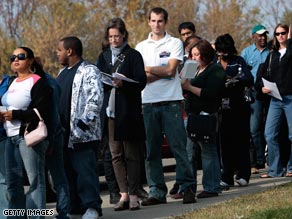
Seeing as we were talking about the good and bad sides to early voting last week, i thought i would look up how the early voting was going in this election. When i did, i was really surprised to find out that even in early voting lines, people have had waits of over 6 hours.
I would not have expected such a turnout to early voting, but i think that this just shows us how necessary it is for the election. Just think about what would happen if all these people waited until the day of the election to vote, while there have been voting problems in the past, this greatly increased interest suggests that the availability of voting time and locations needs to be increased. I'm sure that in having such long lines, many people are either disinclined to vote, or simply can't do it because they have other things to do. Because of this i think that they should either have the polls open for a longer period of time during the day, or just have more polls to go to. Something about the system needs to be changed because it is not capable of supporting this turnout. I know that the rules of the election give the candidates a deadline of election day to prove their point, but think that the availability of early voting is more of a positive effect rather than negative. While few people are likely to change their minds over the course of the last couple weeks, the early voting gives many a chance to vote when otherwise they could not have.
Regardless of the problems with lines and waiting, the turnout for the voting is encouraging. It really appears that people now are far more interested in the outcome of the election and are willing to go out of their way to have their vote counted. http://www.cnn.com/2008/POLITICS/11/02/early.voting/index.html
Monday, October 27, 2008
A School Without Teachers or Classes?
After our conversation in class today about the grading system at New Trier and how it is apparently contrary to the mission statement, i was intrigued to find out if there were any schools that had a drastically different approach to education which does help the students become intrinsically motivated to learn. After a quick search, i found an article about New Country School in Henderson, Minnesota that has no classes, no walls, and no teachers. The basic idea of the school is that the students work on projects that are designed to fulfill state requirements for education, but other than a deadline, there is almost no input from teachers. The students will work how they want, some on their own, some in groups, but all with the freedom to do as they will. If they get tired of working on one project, they can switch to math, or reading whenever they want. These projects will eventually be presented to the rest of the school and staff when they are due. According to the article, the students enjoy the relaxed environment, and even though they don't have teachers breathing down their necks to make sure they work, the school performs well above the state average on standardized tests, and 90% of the students go on to college when they are done.
This system would hardly work for New Trier, seeing as New Country has 124 students, and New Trier is closer to 5,000, but it is an interesting approach to education. This way, all the students get to study what they are interested in and want to study, while still meeting state requirements. While New Trier couldn't do this to the same scale, i think that we could definately look at this school and take some of their ideas.
This system would hardly work for New Trier, seeing as New Country has 124 students, and New Trier is closer to 5,000, but it is an interesting approach to education. This way, all the students get to study what they are interested in and want to study, while still meeting state requirements. While New Trier couldn't do this to the same scale, i think that we could definately look at this school and take some of their ideas.
Sunday, October 19, 2008
Presidential Race: Idealism vs. Pragmatism
Because we are learning about the history of American government and its relation to idealism and pragmatism, i wanted to see how the two candidates in the presidential race fit into the two mindsets and how the American people reacted to it. I wonder, do the American people want to see a display of idealism, or do they want a specific (pragmatic) approach to the future? While politicians are famous for displaying their lofty ideas to the public, dictating appealing solutions without really backing them up, i think that the public has become wary of this tactic and is looking more closely into the politicians plans. This election has recorded the highest public interest rate in history, and those following it have been wary of the various political techniques. The biggest example that i can think of showing idealism vs. pragmatism is when the candidates were asked what they thought they would have to cancel from their plans as president because of the recent economic downturn. Immediately, Obama began listing things that he may not be able to do, but McCain simply said he would find a way to do everything. With McCain's notably idealist approach to his campaign, and Obama's hint towards pragmatism, it is interesting that Obama has been considered to have won all three of the presidential debates, and McCain has been struggling in the polls. Maybe the time has come when the public will no longer fall victim to idealist claims and promises, looking instead for realistic plans.
What happens when what you fear is the only option?

In the process of learning about the origins of the Constitution of the United States, I looked back at the governments bailout of the banking system and realized how contrary it was to everything that the founding fathers worked for. The constitution that they wrote had the primary objective of outlining a government that would be ruled by the people, for the people, not interfering with their privacy, property, or the economy. With a profound fear of oppressive governments, this document was supposed to be a solution. Despite relatively few amendments, the country has followed the constitution word for word for hundreds of years, taking pride in upholding the sense of individuality that it protects. This bailout is different. By implementing hundreds of billions of dollars into the banks, the government has effectively bought their way into the economy, regulating it to try and save it from this downturn. The very thing that the founding fathers worked to remove from their government has come back. So what happens when perilous times force that which you fear to be the only perceivable solution? Maybe it's when idealism steps aside to allow pragmatism to take over. The American people fear changes in the constitution, they fear socialism, they fear government power, but when it comes down to it, the constitution was written in a different time, and the ideals of founding fathers may not be enough to keep the country in order. Whether a change in the Constitution is needed or not, i don't know, but the current situation in America definitely leads one to ask.
Monday, October 6, 2008
Will The Bailout Work?
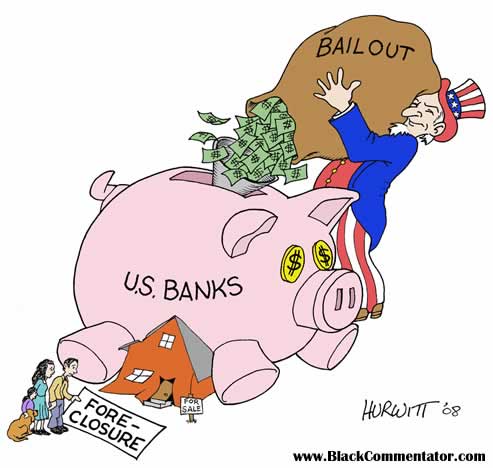
In light of studying the Great Depression of the 1920's, i was looking for more articles on the current economic situation that we are in. The primary issue at the moment is that the credit system around the country is frozen, because too many people have taken out loans that they cannot afford. To this point, much of what is going on seems to parallel America of the 1920's except that now the government is attempting to do something about the problem. With the now passed $700 million bailout plan, the government is planning on buying up all the banks bad loans and debts, and as a result, freeing the credit industry once again. This all sounds very nice, but it seems to me that it can't be that easy, that more is going to have to happen in order for the economy to right it's ways. Thinking of this, i found an article on CNN in which they explore why the bailout won't work. The author says that the bailout is just a temporary fix, and that people's confidence in the market wont increase, and nobody is going to buy more after it is enacted. The author also says that the banks won't want to give out any loans still because they don't believe that the bailout will be effective. As far as he's concerned, the bailout is just $700 million gone to slow down the decline of the U.S. economy.
To me this makes sense. The way i see it is that it must be the system itself that is flawed. If Americans before took out loans that they couldn't pay for, whats going to stop them from doing now, or later on. I don't see how the bailout will stop the problem from happening again because it is just putting money into a system that is failing. While i am not presenting a better solution, i just can't see how this is going to help, not to mention the fact that my children and grandchildren are going to have to pay for all of this. I guess there is nothing to do but wait at this point and see what happens to the market. http://money.cnn.com/2008/10/04/news/economy/will_it_work/index.htm?postversion=2008100408
Subscribe to:
Posts (Atom)